This year I took some time to dive into stories about women in the Hebrew Bible in a series of Facebook posts.
One of my favorites was the Widow of Zarephath. This series was originally four posts. I’ll modify and condense it into three. This is part one.
God Knew the Widow of Zarephath
We find the story of the Widow of Zarephath in 1 Kings 17. It is one of my favorite stories in all of the Hebrew Bible. The reason why I love it so much is because it shows that God knew and cared about the Widow living in an idolatrous town that was a non-believer. In this story, God shows up and moves in the life of a person at the margins in miraculous ways.
Background
Before diving into the story, it’s important to know some background. According to the Biblical text, at this time the Israelites are being extremely wicked and worshipping the idol Baal. The rulers at the time, Queen Jezebel and King Ahab are also extremely wicked and are actively seeking to kill Elijah, the prophet, who is in hiding. During this time, the people are also facing a severe famine, which has been going on for three and a half years. Because Elijah is in hiding during this famine, it is difficult for Elijah to find food and water.
God provides for Elijah by having ravens bring him bread twice a day so he doesn’t starve. This is reminiscent of the manna of heaven and is a great indication of God’s ability to unilaterally provide for his prophet. For water, Elijah gets it from a small brook. And then the brook dries up because there hasn’t been any rain. At this point in the story, God tells Elijah, “go to Zarephath and a widow there will sustain thee.”
As I’ll show in this post, this is not an easy request. It is anything but simple.
Zarephath
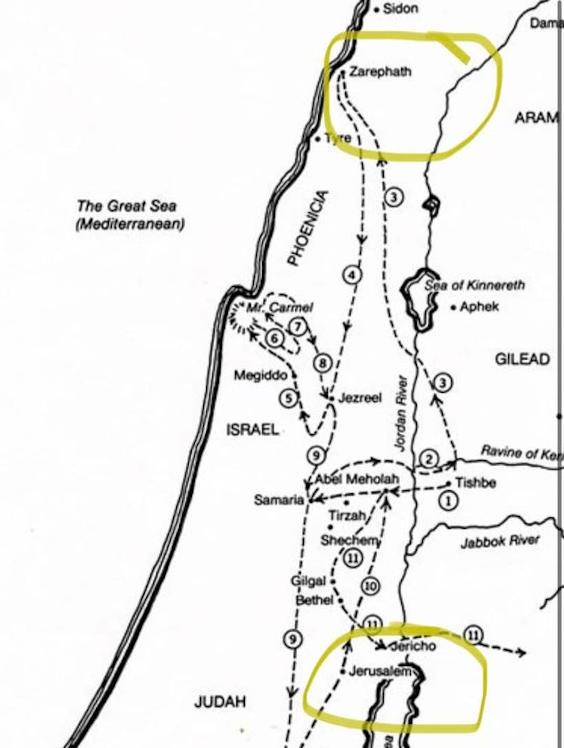
It is deeply important to this story to know more about Zarephath. As the crow flies, Zarephath is about 115 miles from Jerusalem. While we don’t know exactly where Elijah was, we know he was approximately 29 miles from Jerusalem. So going to Zarephath is not a quick jaunt to just any nearby city. It’s some 100 miles away! (Note: Zarephath would be near Tyre or Sidon (in modern-day Lebanon).)
That distance in and of itself would make this journey extremely difficult. However, to add more difficulty. Zarephath is also in the heart of Baal-worshipping territory and is close to the home city of Baal-worshipping Queen Jezebel who wants Elijah killed. Zarephath was deeply dependent on the town of Sidon (the very heart of Baal territory). So Zarephath was one of the least hospitable places God could send Elijah—a city full of idolaters who want Elijah killed. Sending Elijah here makes little objective sense.
Widow
One of the great travesties of this story is that we do not know the name of this remarkable woman. Instead, we only know here in relation to the man in her life—widow. It’s distressing that such a remarkable woman’s name was not noted.
We know little about the widow of Zarephath, unfortunately. We know she was a resident of Zarephath. We know that as far as the Israelites and prophetic authors of the Biblical text are concerned that she is a foreigner, a gentile, and most importantly, not an Israelite. Preceding this story, readers are met with tale after tale of Israelites killing non-Israelites in horrific acts of mass destruction. So this “other-ness” is even more important.
We knew from 1 Kings 17:12 that she has some vague familiarity with the Hebrew faith and with the Hebrew God because she recognizes Elijah as a Hebrew worshiper of Yahweh (Jehovah). (Note: more on this in subsequent posts). However, for now, it’s notable that the does not claim Yahweh as her god; she says “your God.” She is not and does not claim to be a follower of Yahweh.
And as her name suggests, we know she’s a widow. We do not know when her husband died, however. Did he die in the famine (sometime in the last three and a half years)? Many years ago? Weeks ago? Days ago? Months ago? How long has she been trying to get by with just her and her son? Also, how old is the son?
The widow is facing a pretty desperate situation. She and her son are both about to die from starvation.
Notably, being a widow during biblical times was always precarious since unless “they remarried or had family who could care for them, widows were often destined for poverty or destitution.” (Leigh Powers, linked below)
This is why the Hebrew Bible and New Testament are replete with examples of God commanding people to look after the widows. (See Deuteronomy 26:12, Exodus 22:21-23). However, when Israel is wicked and turns away from serving God, they also “turn[] away from his commandments. Who suffered when that happened? Widows were among the first casualties. The [Hebrew Bible] prophets reproached those who wronged widows and called the nation back to its God-given responsibilities (e.g., Isaiah 10:1-3, Jeremiah 22:1-5, Ezekiel 22:6-7)” on multiple occasions. (Crossway, linked below)
The Widow was not an Israelite. While it seems unlikely the Baal worshippers had such obligations to care for widows, they may have. However, what we do know is that when people are prideful and idolatrous, they rarely care for widows, so it is likely the Baal worshippers did not.
A widow without male support faced danger as they were easy prey for economic and social abuse and exploitation. This is why Naomi was so distraught for her widow daughters-in-law, who she told to leave her and go home to their families because she has nothing to offer them. She is also a widow as they are and believes she cannot offer them any kindness or support. Being a widow in this society was perilous.
Thus, not only is Zarephath a very strange and nonsensical place for God to send a starving prophet to, but sending him to a widow also seems nonsensical. She is likely to be among the least likely to be able to help and belongs to a city least likely to help. Elijah would have known this and goes anyway, which is quite remarkable.
Why?
God had been feeding Elijah by sending ravens to him. So why send him some 100 miles away to a widow in Zarephath, an unbelieving town, and to a nonbeliever to provide him with food?
The simple answer is the one Christ provides in Luke 4:24-28: “No prophet is welcome in his hometown.” Here, he directly mentions Elijah and the Widow of Zarephath.
However, I think it’s more complex than this. Either way, it shows that God knew of and was aware of the Widow of Zarephath, her heart, her great potential for faith, her charity, and also her desperate situation. He knew her, a non-Israelite, a non-believer, and that’s important. He knew she needed help and designed a path for her to gain that help by helping others.
Again, God didn’t need the Widow to feed or help Elijah. He could have chosen literally any other solution he wanted. (Again think about the ravens.) Likewise, God didn’t need to send Elijah to help the Widow. He could have come up with other solutions to help her. The fact that he chose them to help each other is quite remarkable. It allows both of them to be helpers.
It shows us that God sees something exceptional in this widow. He knows that not all the residents of Baal-worshipping Zarephath are morally bankrupt. He knows her and her heart. For a people and Bible that has been defined by male aggression and violence, this is noteworthy.
What This Teaches Us?
My favorite lesson from this story is that this story shows: “Fundamentally, God is the kind of God who keeps a careful eye on the widow. He is profoundly concerned for her, together with the stranger and the fatherless. He is righteous and protects them for he is ‘a father of the fatherless, a defender of widows . . . in his holy habitation,’ Psalm 68:5.” (Crossway, linked below)
That’s what resonates with me. All through scripture, we see God (especially in the New Testament), siding with and keeping an eye on the marginalized, going after the one, and admonishing us to take care of the poor, the widow, the orphan, the forgotten, and the cast out. And despite ample stories where that appears to be missing from the Hebrew Bible, this is a powerful reminder that this same theme is woven throughout the Hebrew Bible as well. God constantly seeks out and shows up for those on the margins. We see this with Hagar, the widow in 2 Kings 4, and Ruth.
The God I know and recognize goes after the one, and this story shows that with abundant clarity.
That’s one reason this story is so remarkable. Here, we have scriptural evidence that God knew a non-believing widow in an obscure, apparently idolatrous city. He knew her situation, her desperation, and her heart. He sent Elijah to her so she could be helped. He was looking out for a single mother and her son who were facing death—and then again looks out for her again when her son dies/almost dies a second time. He didn’t send Elijah some 100 miles for food; he sent him for the Widow of Zarephath.
Why This Matters?
I think we have the same call today—to look out for the widow and the marginalized, and to be deeply aware of their situations. We know God cares about the widow, the single mom, the orphan, and the cast out, and he wants us to care too.
Part two can be found here. Part three can be found here.
Citations
Note: I read several more scholarly articles, but I purposely cited and quoted from those that are most easily accessible.
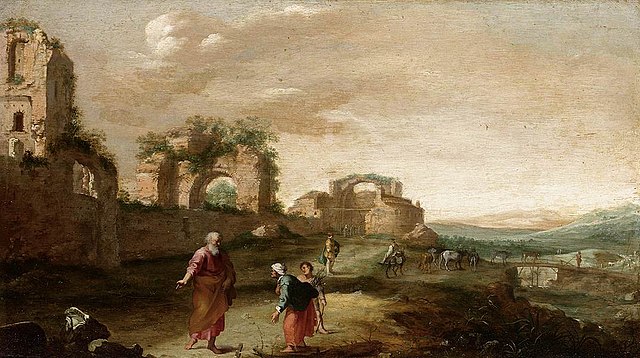
Photo: Elijah and the Widow of Zarephath (public domain)
 Half Drafted