This year I took some time to dive into stories about women in the Hebrew Bible in a series of Facebook posts.
One of my favorites was the Widow of Zarephath. I will condense this into three parts. This is part three. Part one can be found here. Part two can be found here.
The Widow’s Interaction with God
The story we have in 1 Kings 17 is told from Elijah’s perspective and through his eyes. That is the case with most of scripture—rarely is anything told through a woman’s eyes. However, I’d invite everybody to try to step in women’s shoes when reading the text as often as possible. Take a step back and dive into what is left unsaid.
In the case of the Widow, diving into her story reveals a lot.
As I indicated in part one, 1 Kings 17:9 contains a very important nugget we mostly left untouched in verse 2. God tells Elijah that he has commanded and instructed a widow woman to provide for him. Why is this conversation with God/God’s messenger missing? Did God personally instruct the Widow? How was she instructed? When? What was she told and by whom?
The text is clear that God interacted in some way with the Widow (a non-Israelite), and this is left out of the text. That is astounding!
While we are missing her encounter with God, we learn briefly about her interaction with Elijah. What’s remarkable here is is that she a non-believer uses the name of God when she responds to Elijah. Israelites rarely used this name out loud, and when they did, they often mispronounced it because they felt it was too sacred to be used. This makes the fact that the Widow says it immediately upon hearing Elijah’s request that much more fascinating. What must Elijah have thought? Likely little, as God has told him he would instruct a widow to care for him, but he still must have had questions about this encounter as well after hearing her. But what does this reveal about the Widow’s encounter?
So much is left unsaid here. Too much is left unsaid.
However, it’s clear she spoke with a messenger of God, if not God directly. If the latter, it wouldn’t be the first time God directly appeared to an unlikely character. God appeared to Hagar, as we’ll discuss below (Note: Angle of the Lord was another way of saying God, and most Hebraic scholars believe God himself appeared to Hagar when she named him and interacted with him.) The story of God appearing to Hagar is deeply meaningful to me and to many others, which makes it even sadder that the Widow’s interaction is absent from the text.
When God or his messenger first appeared, did she think it was from Baal at first? What all was said? What instructions were given? What did she think? How did she feel? How long ago was this message given?
Wil Gafney sums it up well: “Why is her conversation with God missing from the text? We know why. She was a woman and foreigner, considered disposable by the framers of Israel’s scriptures who used her as a narrative tool.
“But no one is disposable to God. Even they are disposable to the […] God in the text, no one is disposable to the God who transcends the text, the God beyond the text.”
Whatever happened, it wasn’t enough to fully convince her to follow this God or to claim him as hers, at least not yet.
Perceived Punishment of God
After the Widow has given Elijah her bread and received the miracle, we learn in 1 Kings 17:17 that her son falls seriously ill, so ill that he’s not breathing. Many take this to mean he was dead. But if he wasn’t dead, he was at least close to it.
Upon seeing this, she immediately turns to Elijah and in simplified language says, “What do you have against me, man of God? Did you come to remind me of my sin and kill my son?”
This really stood out to me when reading through this story. She has been compassionate, kind-hearted, and faithful, and she has received a miracle. And yet, when her son dies, she automatically believes it’s her fault and punishment from God. That’s the image of a god she has been acquainted with and found in Baal. A cruel, harsh god. And yet, I think even we, who serve the God of Elijah, still react the same. When bad things happen or good things fail to arrive, we often believe it’s a punishment for some bad act or shortcoming.
The anguish in this verse again leaps off the page. She is a widow, so her son’s death means her only hope for a future is for her son to grow up and be able to provide for her. She may or may not still be actively mourning the loss of her husband, and now she’s faced with the loss of her son. (Compare with Naomi’s grief over the loss of her sons and husband.) If her son dies, she would be left without kin to care for her, which would be very precarious.
Also, she has been facing and preparing for the death of her and her son. Then she is met with a miracle, and then her son dies anyway. The anguish this moment would bring—to face the death of your son, twice. To have stared down death, come out conqueror, only to lose your son in the end anyway. This is a soul-crushing moment.
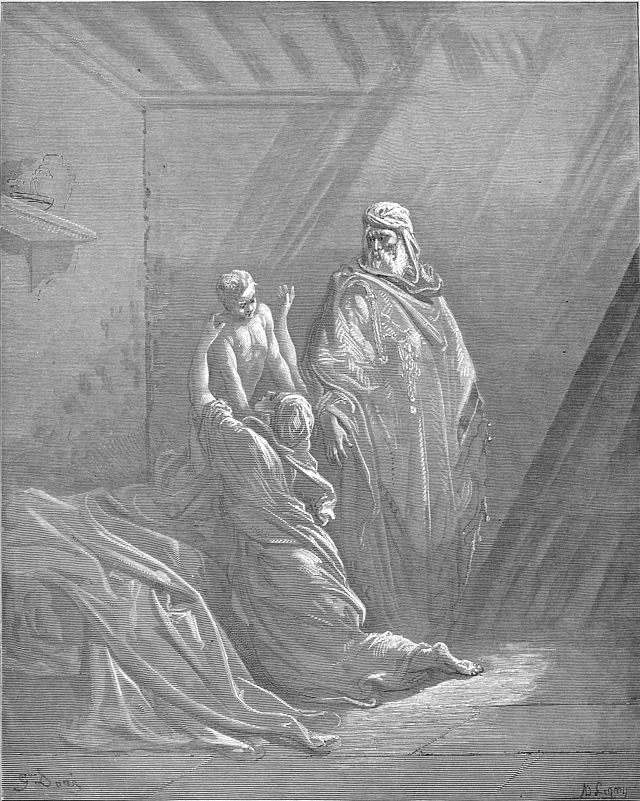
But thankfully, the story doesn’t end here. We read that Elijah takes her son, goes into a different room, cries over the son and stretches himself over the child three times, and then the child’s soul comes back into him. The child doesn’t remain dead. The story ends with her affirming her faith in God and calling him as a man of God. She finally claims God as her own. And then we never hear anything directly about the Widow again. This is also a travesty. I wish we would know more of the Widow’s journey.
God’s love of Single Mothers
As I’ve repeatedly mentioned, this story reminds me of Hagar. Abraham, at Sarah’s command, kicks Hagar and her son out of their community. So in essence, Hagar is a single mother, like the widow.
Hagar and her son are dying of thirst in the desert, and like the Widow, death seems certain for her and her son. Hagar walks away from her child because she can’t bear to see him die, in a great parallel to the anguish that the Widow clearly felt. Hagar doesn’t have enough food or water to provide for her son. She is helpless and death seems certain.
Here, God doesn’t act through the prophet—perhaps because the prophet is also one who exiled her from the community. Instead, he acts directly. God shows up directly and provides a miracle for Hagar—water, comfort, and direction.
I love that in the midst of all the violence and misery we find in the Hebrew Bible, we see God show up powerfully and unmistakably for two single mothers who either will are not Israelites.
Hagar was an Ethiopian slave. The Widow a Sidonian. While Hagar conceived Abraham’s child (technically Sarah’s), this was not the lineage the Hebrew Bible tracks or reveres. Both are unlikely women for God to appear to or rescue. Hagar is at the margins, cast out, and forgotten. And yet, God steps in directly.
I love that God steps in for both Hagar and the Widow. With these two moments, we can begin to see an important pattern emerge. In the midst of a very violent, male-oriented text, the text states that God stepped in twice to save single mothers and their sons in distress. One by appearing directly and one by at least orchestrating a plan to save her and her son.
This is a God I recognize.
Photo: Elijah Raises the Son of the Widow of Zarephath by Gustave Dore
 Half Drafted