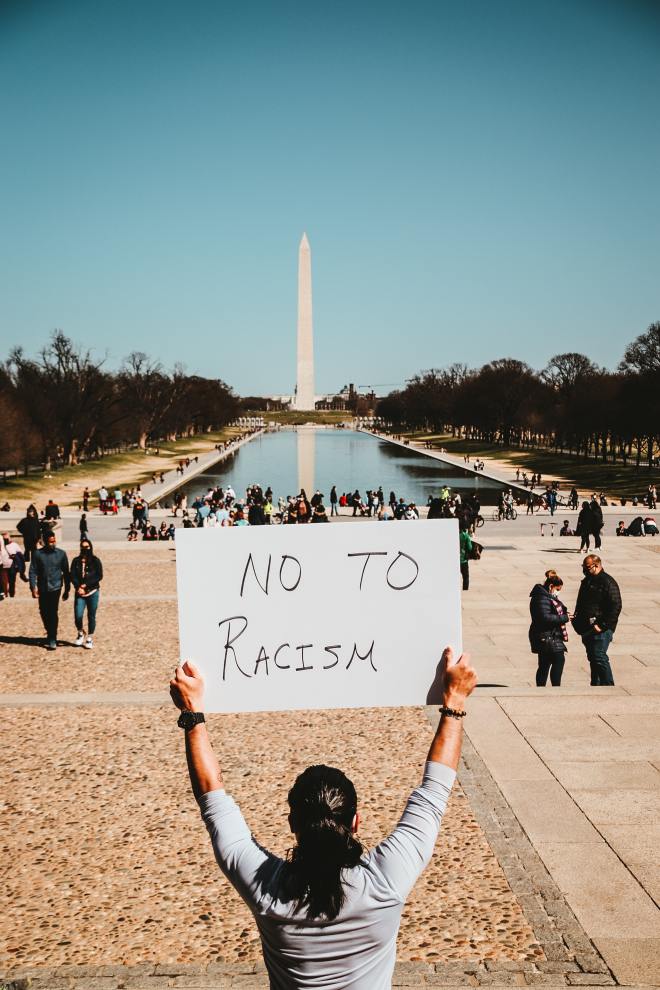
Today a senator in my state publicly said “anti-racism is racism.” Two years ago, a Utah school made “Black History Month” optional for students. The sad reality is I could continue with story after story about Utah legislators and education bodies getting it wrong and terribly wrong when it comes to race in Utah. I could cite article after article about schools and students being investigated for horribly racist incidents, most recently where students shouted racist slurs and barked at Asian American and Polynesian players.
And this isn’t new. When I was in junior high, we played a game where students could buy and trade slaves to make money or not directly buy them but still participate in the Middle Passage in other ways (indirectly buying and selling), my friend was called the N-word in soccer games more than once, and more.
Sadly, it hasn’t changed much since then either.
“CRT” and “wokeness” and “political agendas” and DEI and antiracism have become flashpoints for many politicians and pundits and new culture wars and wedge issues. And usually, they quote Rev. Dr. Martin Luther King, Jr. in the process absent all context.
King was speaking at a time when all certain people saw was color and race. People were actively barred from equal participation because of race. He was advocating for people to see past that and to the character of people.
This stance got morphed into color blindness. I think Marie Beecham does a great job discussing this: “In recent US history, blatant racial discrimination was legal and fully acceptable. White people were thought of as superior to people of color. The underlying belief: that people of different races are inherently different.”
This is the context in which King said, “I have a dream that my four little children will one day live in a nation where they will not be judged by the color of their skin but by the content of their character.”
It’s also important to note this is one line of hundreds and hundreds of speeches he gave. I’ve been slowly making my way through a book called A Testament of Hope: The Essential Writings and Speeches by Martin Luther King Jr. It’s 702 pages long!
The best way to know what King meant is to read that book and his speeches pretty expansively. I think that makes it pretty clear what King meant by this statement. Those who use this quote often ignore every other thing he said that could make it clear he wouldn’t agree with how they are using this quote.
And if we have further questions as to his intent, statements by Coretta Scott King and all of King’s children who are still alive and in this work have decried how people are misusing that quote and provided further context.
When he gave that speech, he lived in a society where he was receiving calls where people were threatening to blow up his home, he was arrested because of his skin color, he led movements where people were beaten and killed and churches were bombed because of skin color. So yes, he was hoping people could look past skin color. Because nobody saw anything but color.
Color was an immovable line drawn in the sand that nobody crossed. They were advocating for people to see past color. And the movement of color blindness materialized and evolved from there and was and has been contorted ever since.
As Marie Beecham says, “Color blindness is the conscious choice to ignore race as much as possible. It would be a perfect solution if race were the issue. But race is not the issue. Racism is the issue. Our racial differences aren’t a problem to ‘fix.’ Discrimination is the problem that needs fixing. But by not choosing to ‘see’ race, you choose to not ‘see’ racism. Color blindness prevents you from ever recognizing, let alone addressing, racial injustice.”
She continues, “I can’t get behind color blindness because it equates unity with uniformity, misidentified race as the issue rather than racism, and enables people to ignore racism.”
I also often hear “if people stopped talking about racism, then racism would disappear.” I think Beecham did a good job of stating why that’s not the case. Even if we never talked about race again, the systems in place that have been in place for decades would not change.
People may disagree with what is the best approach to achieve antiracism. People may disagree with certain antiracist theories or efforts. However, antiracism is not racism, and I believe antiracism is crucial.
Antiracism is the policy or practice of opposing racism and promoting racial equality. Another definition is that antiracism is a collection of antiracist policies that lead to racial equity. An antiracist policy is any measure that produces or sustains racial equity between racial groups. And racial equality is when different racial groups share the same level of power in a society.
By definition, antiracism is not racism. Antiracist theorists may disagree on how to best achieve these outcomes, but antiracism is not racism. While that should go without saying, apparently it needs saying. And antiracism is desperately needed.
Antiracism also honors the intent of King’s hope for his kids “not to be judged by the color of their skin but by the content of their character” by asking for people to see and value them by honoring the reality of their experience, heritage, history, and culture. Antiracism says “don’t judge us based on color” and allows them to exist by asking us to embrace their full humanity. That’s when they can truly be seen for who they are, all of who they are. And that’s the work of antiracism, and I think perfectly aligned with King’s goal.
Antiracism isn’t the villain, racism is. And we should all be committing to do everything to allow people to exist vibrantly in a just and equal society.
Photo via Unsplash license by Viviana Rishe
 Half Drafted